

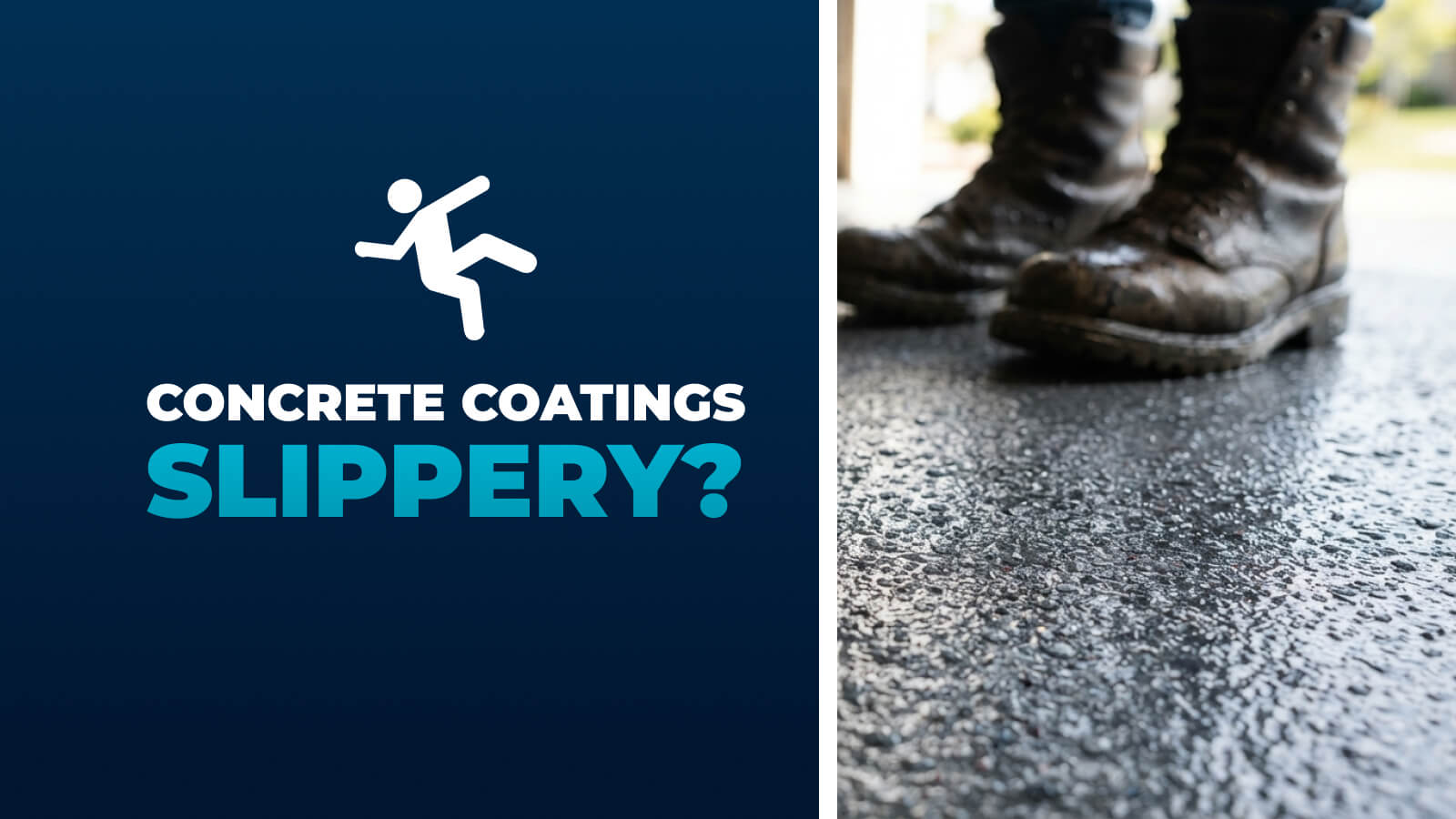
Are Concrete Coatings Slippery? A Traverse City Homeowner’s Guide
If you’re considering a concrete coating for your garage, patio, or pool deck, you’ve probably asked the question: are concrete coatings slippery? The honest answer is yes—especially when wet. A smooth, glossy coating reduces the surface texture your shoes need to grip.
But here’s what most homeowners miss: the slipperiness isn’t built into the coating itself. It’s a choice made during installation. A properly installed concrete coating for a Traverse City home includes an anti-slip additive or textured finish that restores grip without sacrificing durability or appearance.
This guide explains why concrete coatings become slippery, how anti-slip solutions work, and what Northern Michigan homeowners need to know about coating safety through snow, ice, and rain.
Why Do Concrete Coatings Become Slippery?
Film-forming coatings—epoxy, polyaspartic, polyurea, and acrylic sealers—create a protective layer on top of the concrete. On smooth or densely finished slabs, that layer can reduce the texture available for traction. When water, snow, or ice is present, the effect becomes more pronounced.
Three factors make it worse:
1. Excessive Film Build
Applying too much coating, or resealing repeatedly without accounting for existing layers, creates a smoother surface. Thin, correctly applied coats preserve texture.
2. Smooth Concrete Underneath
A power-troweled or densely finished slab has less natural profile to begin with. The coating sits on top and amplifies the smoothness.
3. Wet Conditions
Water acts as a lubricant between your shoe and the coating. Slip resistance drops significantly on wet surfaces compared to dry ones. This is true for bare concrete, too—but a smooth coating can make the drop more dramatic.
The key takeaway: A slippery coating isn’t a coating defect. It’s a missing step. The right additive, applied correctly, solves the problem without compromising the coating’s durability.
The Traverse City Factor: Why Local Homeowners Need to Pay Attention
Traverse City isn’t Phoenix. Our climate creates specific slip hazards that homeowners in drier regions never think about.
- Snow and ice: From November through March, garage floors and patios stay wet. Melting snow from vehicles pools on garage floors. Ice forms at door thresholds.
- Road salt: Salt doesn’t just damage concrete—it keeps surfaces wet longer. Salt-laden slush stays on garage floors and patios, creating a persistent slick film.
- Rain and humidity: Spring and fall bring extended wet periods. Patios and walkways that stay damp for days are prime slip zones.
- Freeze-thaw cycles: Water gets into micro-texture, freezes, expands, and changes the surface profile over time.
This is why non-slip concrete coatings in Traverse City aren’t a luxury—they’re a practical necessity for families, pets, and anyone who parks a car in a garage that stays wet half the year.
How Anti-Slip Additives Work
Anti-slip additives are particles broadcast into the final coat of sealer or coating while it’s still wet. They create microscopic peaks and valleys that give shoes—and bare feet—something to grip.
The type and size of the additive determines both traction and comfort.
| Additive Type | Traction Level | Barefoot Comfort | Best For |
|---|---|---|---|
| Polymer grit | Moderate | Excellent | Pool decks, patios, barefoot areas |
| Aluminum oxide (fine) | High | Good | Garages, steps, walkways |
| Aluminum oxide (coarse) | Very high | Poor | Ramps, commercial, sloped driveways |
| Silica sand (#70) | Moderate-High | Very good | Patios, pool surrounds |
| Rubber particles | Moderate | Excellent | Play areas, pool decks |
Polymer grit is often the best choice for residential patios and pool decks because it provides adequate traction without the rough, sandpaper feel of mineral additives. For garage floors and walkways where barefoot comfort matters less, fine aluminum oxide offers more aggressive grip.
Important: No additive makes a surface 100% slip-proof. Wet, soapy, or icy conditions can still create slip risk. The goal is to restore the traction that a smooth coating removes—not to create a perfect non-slip surface. OSHA’s walking-working surfaces standard requires floors to be kept clean and dry where possible, and recommends surfaces coated with grit for slippery areas [citation:3].
Garage Floor Coatings Traverse City
Garages are the highest-risk area for most homeowners. Vehicles track in snow, salt, and water. The floor stays wet for hours. Add a smooth polyaspartic coating without texture, and you’ve created an ice rink.
Best approach: Polyaspartic base with fine aluminum oxide or polymer grit broadcast into the topcoat. This gives traction under wet tires and boots without being uncomfortable to walk on in socks or bare feet.
Why Polyaspartic for Garages
It flexes with freeze-thaw cycles, resists road salt, and won’t yellow like standard epoxy. For Michigan garages, it’s the practical choice. Our polyaspartic systems are engineered for Michigan winters—4x stronger than epoxy, with a 15-year warranty.
Concrete Patio Coatings Traverse City
Patios are barefoot territory. Rough additives are out. You want traction that feels comfortable underfoot while still providing grip when wet.
Best approach: Polyaspartic or flexible polyurea coating with polymer grit or #70 silica sand. These additives provide moderate traction without the abrasive feel of aluminum oxide.
Consideration: Shaded patios stay wet longer. North-facing patios may need a slightly more aggressive texture than south-facing ones.
Patio tip: If you plan to walk on the patio barefoot—kids, dogs, lounging—polymer grit is the better choice. If it’s mostly a walkway to the grill, fine aluminum oxide works and lasts longer. Learn more about polyaspartic patio coatings.
Pool Deck Coatings
Pool decks are the most safety-critical application. Wet feet, splashing water, and smooth surfaces are a dangerous combination.
Best approach: A textured polyaspartic or polyurea system with a slip-resistant additive rated for wet environments. Public pool regulations in many jurisdictions require decks to have slip-resistant, textured finishes that are safe under bare feet in wet or dry conditions [citation:4].
Barefoot comfort: Polymer grit is the standard choice for residential pool decks. It provides traction without shredding feet.
Pool Deck Additive Pairing
- Lounging areas: Polymer grit or #70 silica sand for barefoot comfort.
- Pool edge and steps: Fine aluminum oxide for extra grip where safety is paramount.
- Sloped walkways: Medium aluminum oxide for maximum traction.
Driveway Coatings
Driveways are often sloped, which increases slip risk. They also face the harshest weather and the most vehicle traffic.
Best approach: A flexible polyurea or polyaspartic coating with fine to medium aluminum oxide. Sloped driveways may need a coarser additive for additional grip.
Note: Standard epoxy is a poor choice for driveways. It’s brittle, yellows under UV, and struggles with freeze-thaw movement. Polyaspartic coatings are engineered for outdoor use and Michigan’s temperature swings.
Common Mistakes That Make Coatings Slippery
- Skipping the anti-slip additive entirely. This is the most common mistake. A smooth coating looks great in photos and feels dangerous underfoot.
- Using the wrong additive for the application. Coarse aluminum oxide on a pool deck will tear up bare feet. Polymer grit on a steep driveway won’t provide enough traction.
- Applying too much coating. Thick coats fill in texture and create a glassy surface. Thin, correctly applied coats preserve profile.
- Over-sealing. Adding a new coat of sealer every year without considering existing film build creates an increasingly smooth surface.
- Ignoring slope and drainage. Water that pools on a coating—any coating—increases slip risk. Proper drainage and grading matter as much as the coating itself.
- Not testing the finished surface. A simple wet-foot test on a small area before the coating cures can reveal whether the texture is adequate.
The pattern in all six mistakes: Someone treated the coating like paint and skipped the engineering. A garage floor, pool deck, or driveway isn’t a wall. It’s a working surface that has to stay safe when it’s wet.
How Professional Installation Solves the Problem
A professional installer doesn’t just roll on a coating and leave. They engineer the surface for its specific use.
- Surface assessment: The installer evaluates the concrete’s existing texture, slope, and drainage. A smooth, power-troweled slab needs more aggressive profiling and a more substantial anti-slip additive.
- Correct additive selection: Polymer grit for barefoot areas. Aluminum oxide for garages and walkways. The right choice depends on who uses the space and how.
- Proper application technique: Additives must be evenly dispersed and broadcast at the correct rate. Clumping or uneven distribution creates inconsistent traction.
- Quality materials: Professional-grade polyaspartic systems are formulated to hold texture over time. Thin, water-based DIY kits wear smooth quickly.
- Warranty and accountability: A professional installation comes with a warranty that covers the coating’s performance—including its texture.
For homeowners in Traverse City, choosing an installer who understands Northern Michigan conditions matters. A coating that works in a mild climate may fail here. Polyaspartic systems designed for freeze-thaw cycles and road salt exposure are the standard for this region. Great Lakes Concrete Coatings installs slip-resistant polyaspartic systems across a 50-mile radius of Traverse City, including Charlevoix, Petoskey, Cadillac, and Manistee.
What to ask your installer: “Which anti-slip additive are you using, at what rate, and why did you choose it for this surface?” A professional will have a clear answer. A roofer-turned-coater might not.
Frequently Asked Questions
Are concrete coatings slippery when wet?
Yes, any smooth coating can become slippery when wet. Film-forming sealers and coatings reduce the texture available for grip. However, adding an anti-slip additive during installation restores traction. A properly textured coating is significantly safer than an untextured one—though no surface is completely slip-proof in all conditions.
Can I add anti-slip additive to an existing coating?
In most cases, yes—but it requires applying a new topcoat with the additive mixed in or broadcast on top. You can’t simply sprinkle additive onto a cured coating. A professional can assess the existing coating and recommend the best approach.
What is the best anti-slip additive for a pool deck?
Polymer grit is the most common choice for residential pool decks because it provides traction without being abrasive on bare feet. #70 silica sand is also a good option. Coarse aluminum oxide is too rough for pool deck use.
Will anti-slip additives make my floor harder to clean?
Slightly, yes. Textured surfaces trap a small amount of dirt in the peaks and valleys. A soft-bristle brush or microfiber mop handles routine cleaning. The trade-off is worth it for the safety improvement—especially in wet climates like Northern Michigan.
Do I need a non-slip coating in my garage if I don’t park inside?
Even without a vehicle, garage floors in Traverse City stay damp from humidity, snow melt from boots, and rain blowing in. A textured coating prevents slips on wet surfaces and makes the floor safer for storage, workshops, and foot traffic.
How do I test if my coated floor is too slippery?
Wet a small area with water and walk across it in the shoes you normally wear. If you feel unstable or the surface feels slick, the texture is inadequate. A professional can apply a textured topcoat to improve traction.
Does polyaspartic coating get slippery?
Polyaspartic coatings cure to a smooth, glossy finish by default—just like epoxy. Without an anti-slip additive, they can be slippery when wet. With the right additive, polyaspartic provides excellent traction while maintaining its durability and UV stability.
Conclusion
Concrete coatings aren’t inherently slippery—but smooth, untextured coatings can be dangerously slick when wet. In Traverse City, where snow, ice, and rain keep surfaces damp for months, slip resistance isn’t optional.
The solution is straightforward: choose a professional installer who adds the right anti-slip additive for your specific application. Polymer grit for patios and pool decks. Fine aluminum oxide for garages and walkways. The correct texture for the way you actually use the space.
Don’t let a beautiful coating become a hidden hazard. If you’re not sure what your floor needs, ask someone who installs these systems every day—not someone who’s guessing.
Ready to make your concrete safer? Great Lakes Concrete Coatings installs slip-resistant polyaspartic systems built for Northern Michigan weather. We’ll assess your surface, recommend the right additive, and deliver a floor that looks great—and keeps your family safe through every season. Call (231) 299-6960 for a free on-site quote.