

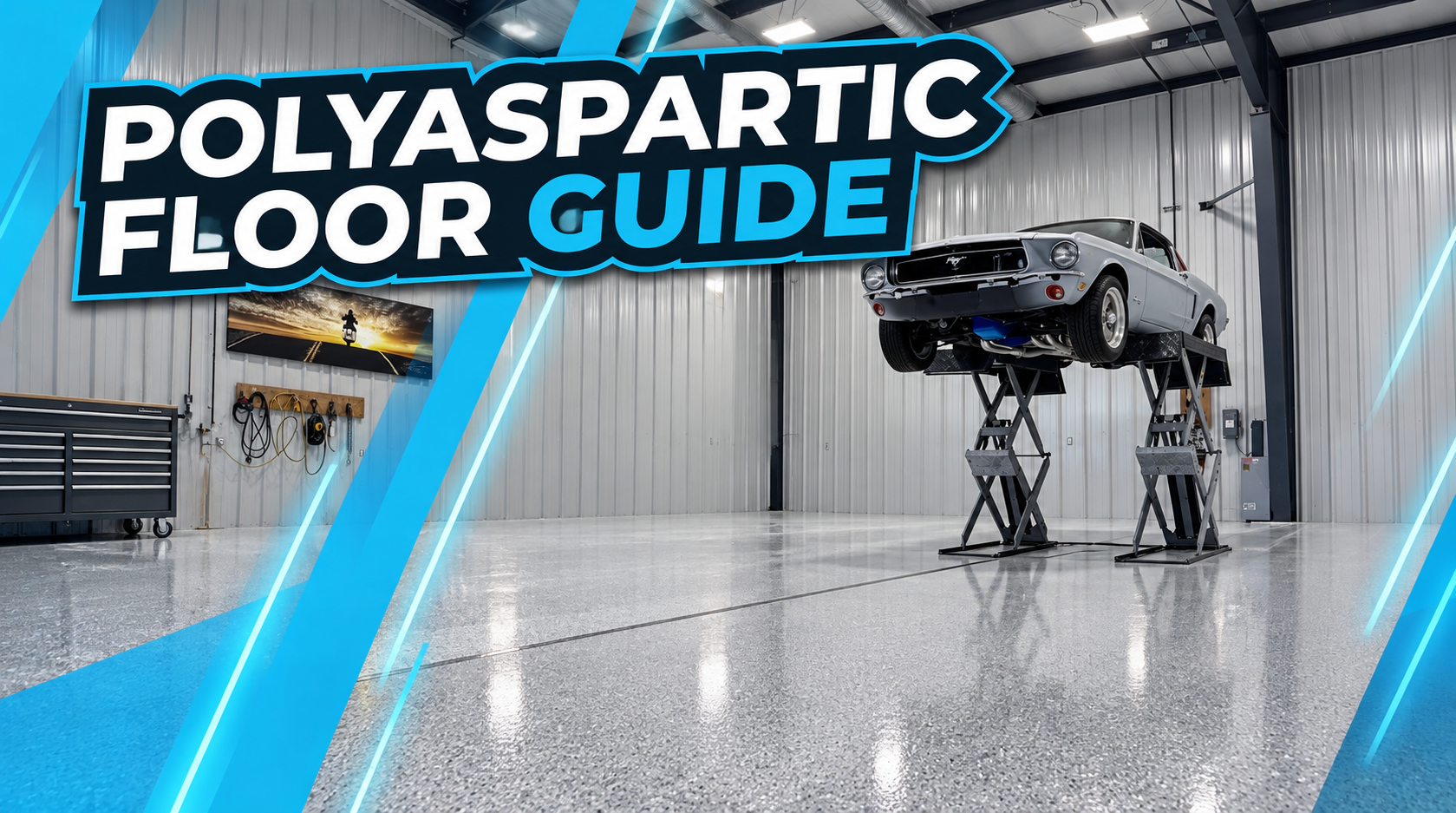
What Is Polyaspartic Floor Coating? Complete Guide
Polyaspartic systems are used in garages, workshops, basements, commercial spaces and selected outdoor applications. Homeowners often consider them when they want to transform bare or damaged concrete into a more attractive and easier-to-maintain surface.
But choosing a floor coating shouldn’t come down to the product name alone. The concrete substrate, surface preparation, coating system, installation conditions and intended use all affect the final result.
This guide explains what polyaspartic floor coating is, how it works, its benefits and limitations, how it compares with epoxy, how it is installed, how long it can last, what affects its cost, and whether it is right for your concrete floor.
What Is Polyaspartic Coating Made Of?
Polyaspartic coatings are part of a family of polyurethane-related coating technologies.
Without getting overly technical, polyaspartic chemistry allows manufacturers to formulate coatings that can cure relatively quickly while providing a combination of durability, chemical resistance and UV stability.
The exact chemistry varies between products. That matters because not every product marketed as “polyaspartic” has identical performance characteristics.
When comparing contractors, don’t only ask whether they use polyaspartic.
- What specific product are you using?
- What layers are included?
- What is used as the base coat?
- What is used as the topcoat?
- What preparation method do you use?
- What does the manufacturer’s data sheet recommend?
- What warranty is included?
The complete coating system matters more than a single product name.
How Does Polyaspartic Floor Coating Work?
Polyaspartic flooring works by creating a protective layer over properly prepared concrete.
The process generally starts with the concrete itself. A professional installation should address the condition of the substrate before coating material is applied.
1. The Concrete Is Inspected
Before installation, the contractor should look for:
- Cracks
- Spalling
- Pitting
- Oil contamination
- Paint
- Existing coatings
- Weak or dusty concrete
- Moisture concerns
- Damaged areas
- Joint conditions
2. The Concrete Is Mechanically Prepared
Surface preparation is one of the most important parts of a successful floor coating installation.
Professional contractors commonly use diamond grinding or another appropriate mechanical preparation method to remove weak surface material and contaminants while creating the surface profile needed for coating adhesion.
Simply cleaning the floor and rolling on a coating isn’t equivalent to professional preparation.
3. Cracks and Damaged Areas Are Addressed
Concrete cracks, pits and damaged areas may need to be repaired before coating. The correct repair depends on the type and severity of the damage.
A coating can protect concrete, but it should not be used to hide serious structural problems.
4. The Coating System Is Installed
Once the concrete has been properly prepared, the coating system is applied according to the product manufacturer’s specifications.
5. Decorative Flakes May Be Added
For decorative garage floors, vinyl flakes can be broadcast into the coating to create texture, color variation and a finished appearance.
6. A Protective Topcoat Is Applied
The final topcoat protects the decorative system and contributes to the finished floor’s resistance to traffic, chemicals and everyday wear.
7. The Floor Cures
The floor needs adequate time to cure before foot traffic, vehicle traffic or heavy use. Cure times vary according to the product and environmental conditions.
What Does a Polyaspartic Garage Floor System Look Like?
A professional decorative garage floor is typically a multi-layer system, rather than a single coat of material.
A common decorative system can look like:
Prepared concrete
↓
Base coat
↓
Decorative vinyl flakes
↓
Scrape and clean
↓
Protective polyaspartic topcoat
The exact configuration can vary. Some projects may use different primers, base coats, intermediate layers or topcoats depending on the substrate and intended application.
This is why homeowners should ask a contractor to explain the entire system being installed.
What Are the Benefits of Polyaspartic Floor Coating?
Fast Curing and Installation
One of the biggest reasons homeowners consider polyaspartic is speed.
Some professional polyaspartic systems can be installed and returned to service relatively quickly compared with many traditional coating systems.
That can be particularly useful when a homeowner doesn’t want their garage unavailable for several days.
However, “one-day installation” does not mean every polyaspartic product cures identically.
Temperature, humidity, substrate conditions, product specifications and installation technique can affect the schedule.
UV Stability
Polyaspartic formulations are commonly selected for their UV stability.
That can be an advantage in garages that receive sunlight and in certain exterior applications where UV exposure is a concern.
Durability
A properly installed system can provide strong resistance to everyday garage abuse, including:
- Vehicle traffic
- Abrasion
- Dirt
- Automotive fluids
- Household chemicals
- General wear
- Tire exposure
The concrete underneath still matters. Good preparation is essential to achieving the expected performance.
Easier Cleaning
Uncoated concrete is porous and can absorb liquids.
A properly installed coating creates a more seamless, non-porous surface that is generally easier to clean.
Routine maintenance can include:
- Sweeping
- Dust mopping
- Wet mopping
- Prompt spill cleanup
- Manufacturer-approved cleaning products
Decorative Appearance
Polyaspartic garage floors can be customized with different colors and decorative flake blends.
This allows homeowners to create a finished floor that looks considerably different from bare concrete or ordinary garage paint.
What Are the Limitations of Polyaspartic Floor Coating?
Polyaspartic has important advantages, but it isn’t a universal solution.
Preparation Cannot Be Skipped
A coating depends on the substrate underneath it. Oil, weak concrete, dust, failing coatings and other contaminants can interfere with adhesion.
Moisture Can Cause Problems
Concrete can transmit moisture from below. If moisture vapor or hydrostatic pressure is present, it can contribute to coating problems such as blistering or delamination.
Moisture concerns should be evaluated before installation.
Existing Damage May Need Repair
Severe cracks, spalling or unstable concrete should be addressed before coating.
Installation Conditions Matter
Polyaspartic products have specific requirements for application and curing. These can include:
- Temperature
- Humidity
- Substrate temperature
- Mixing
- Application thickness
- Recoat windows
- Cure time
The manufacturer’s requirements should always be followed.
It Is Generally More Expensive Than Basic Garage Paint
A professional polyaspartic system includes labor, preparation, materials and finishing.
Therefore, comparing it with the price of a DIY bucket of floor paint isn’t an apples-to-apples comparison.
Polyaspartic vs. Epoxy: Which Is Better?
Polyaspartic and epoxy are both legitimate concrete-coating technologies, but they have different characteristics.
| Feature | Polyaspartic | Epoxy |
|---|---|---|
| Cure speed | Generally fast | Typically slower |
| UV stability | Generally strong | Varies by formulation |
| Chemical resistance | Strong, product-dependent | Strong, product-dependent |
| Garage applications | Common | Common |
| Decorative flakes | Available | Available |
| Surface preparation | Critical | Critical |
| Initial cost | Often premium | Can be lower |
| Outdoor use | Product/system dependent | More limited for some systems |
For a residential garage, polyaspartic can be attractive when the homeowner prioritizes fast installation, UV stability and durability.
Epoxy may still be appropriate for certain indoor applications and budgets.
The better question isn’t “Is polyaspartic always better than epoxy?”
It’s: “Which complete coating system is best suited to this concrete floor and how it will be used?”
Where Can Polyaspartic Floor Coating Be Used?
Garage Floors
Garages are one of the most common applications.
A garage floor can be exposed to:
- Hot tires
- Oil
- Road salt
- Snow
- Dirt
- Water
- Tools
- Vehicle traffic
A properly installed coating can make the surface easier to clean while providing protection from everyday wear.
Workshops
Workshops can benefit from a durable, easy-to-clean concrete surface.
Polyaspartic can be considered where the floor will experience tools, equipment, automotive fluids and regular traffic.
Basements
Polyaspartic may be suitable for certain basement floors, but moisture should be evaluated first.
A coating should not be installed over a substrate with unresolved moisture problems simply because the surface looks dry.
Commercial and Industrial Floors
Depending on the product and system, polyaspartic coatings can be used in applications such as:
- Auto repair facilities
- Showrooms
- Retail spaces
- Workshops
- Warehouses
- Service facilities
- Commercial garages
Outdoor Concrete
Some polyaspartic systems are designed for exterior use.
However, not every polyaspartic product is suitable for every outdoor application.
Outdoor projects require consideration of:
- UV exposure
- Freeze-thaw cycles
- Moisture
- Temperature changes
- Concrete movement
- Slip resistance
Is Polyaspartic Good for Michigan Garage Floors?
Michigan garage floors deal with conditions that many homeowners don’t think about until the damage appears.
During winter, vehicles can bring in:
- Road salt
- Snow
- Ice
- Meltwater
- Dirt
- Sand
Michigan also experiences significant seasonal temperature changes.
A properly installed coating can create a more durable and easier-to-clean surface, but a coating doesn’t eliminate underlying concrete movement, structural cracks or moisture problems.
For Michigan homes, the condition of the concrete and the quality of preparation should be considered before choosing the coating system.
How Is Polyaspartic Floor Coating Installed?
A professional installation typically follows several stages.
The exact process can vary depending on the contractor and coating manufacturer.
How Long Does Polyaspartic Floor Coating Last?
There is no single lifespan that applies to every polyaspartic floor.
The expected service life depends on factors including:
- Concrete condition
- Surface preparation
- Coating system
- Installation quality
- Traffic
- Chemical exposure
- UV exposure
- Maintenance
- Environmental conditions
This is why homeowners should be skeptical of an installer who promises an exact lifespan without first evaluating the floor.
Instead, ask:
What system are you installing, what does the warranty cover, and what conditions are required to maintain it?
How Much Does Polyaspartic Floor Coating Cost?
The cost depends on the specific project.
Important factors include:
- Garage size
- Square footage
- Concrete condition
- Diamond grinding requirements
- Crack repairs
- Existing coating removal
- Decorative flakes
- Coating system
- Accessibility
- Labor
A garage with clean, sound concrete may require significantly less preparation than a floor covered with failing epoxy, oil contamination and extensive cracks.
When comparing estimates, make sure you know whether the price includes:
- Surface preparation
- Diamond grinding
- Crack repair
- Existing coating removal
- Base coat
- Decorative flakes
- Topcoat
- Cleanup
- Warranty
A lower price isn’t necessarily a lower total cost if important preparation steps are excluded.
Who Should Consider Polyaspartic Flooring?
Polyaspartic can be a good option for homeowners who want:
- A more finished-looking garage
- Easier cleaning
- Protection from everyday wear
- Strong UV stability
- Decorative color and flake options
- Relatively fast installation
- A durable concrete surface
It can be especially useful for garages that double as:
- Workshops
- Home gyms
- Hobby spaces
- Automotive work areas
- Storage areas
- Recreation spaces
When Might Polyaspartic Not Be the Right Choice?
Polyaspartic may not be appropriate when:
- The concrete has serious structural damage
- Significant moisture problems remain unresolved
- The substrate is unstable
- A specialized industrial system is required
- The existing surface cannot provide a suitable bonding substrate
- The project requires a different performance characteristic
A trustworthy contractor should be willing to explain why a particular system is appropriate—or why coating may not be appropriate at all.
What Should You Ask a Polyaspartic Floor Coating Contractor?
Surface Preparation
- Do you diamond-grind the concrete?
- How do you prepare the edges?
- How are cracks repaired?
- How do you handle oil contamination?
- What happens if you find moisture?
- Do you remove existing epoxy?
Coating System
- What products are being used?
- How many layers are included?
- What is the base coat?
- What is the topcoat?
- Is the system UV stable?
- Is it designed for garage use?
Installation
- How long will installation take?
- When can I walk on it?
- When can I move items back?
- When can I park my vehicle?
- What happens if weather or temperature conditions change?
Warranty
- How long is the warranty?
- What does it cover?
- Does it cover peeling or delamination?
- What could void the warranty?
Pricing
- Is grinding included?
- Is crack repair included?
- Is old coating removal included?
- Are flakes included?
- Is the topcoat included?
- Is cleanup included?
Frequently Asked Questions
What is polyaspartic floor coating?
Polyaspartic floor coating is a protective coating technology used on concrete floors. It is commonly selected for garage and commercial flooring because of characteristics such as durability, fast curing and UV stability, depending on the formulation.
Is polyaspartic better than epoxy?
Not in every situation. Polyaspartic can offer advantages such as faster curing and strong UV stability, while epoxy can be appropriate for certain applications and budgets.
Does polyaspartic yellow?
Properly formulated polyaspartic coatings are generally highly UV stable and resistant to yellowing. Always verify the performance characteristics of the specific product being installed.
Is polyaspartic waterproof?
A properly installed coating can provide a highly water-resistant surface, but it does not eliminate moisture or hydrostatic-pressure problems within the concrete.
Is polyaspartic slippery when wet?
Any smooth floor can become slippery when contaminated with water or other liquids. Slip resistance can be improved through appropriate texture or anti-slip additives where needed.
Can polyaspartic be used outdoors?
Some polyaspartic systems are designed for exterior applications. The specific product must be appropriate for UV exposure, moisture, temperature changes and the intended surface.
Can polyaspartic go over old epoxy?
Sometimes. The existing epoxy must be evaluated for adhesion, contamination and condition. Loose or failing epoxy generally needs to be removed rather than simply coated over.
Can polyaspartic be applied over cracked concrete?
Minor cracks may be repairable before coating. Significant or structurally active cracks require further evaluation before a coating is installed.
How quickly can you drive on a polyaspartic garage floor?
Vehicle-traffic timing depends on the specific coating system and environmental conditions. Your installer should provide the manufacturer’s required cure schedule.
Does polyaspartic require maintenance?
Yes. Regular sweeping and cleaning help maintain the floor’s appearance and performance. Spills should also be cleaned promptly using products recommended for the coating system.
Is polyaspartic worth the money?
For homeowners who value durability, appearance, easy maintenance, UV stability and relatively fast installation, polyaspartic can provide strong long-term value. The right choice depends on the concrete and project requirements.