

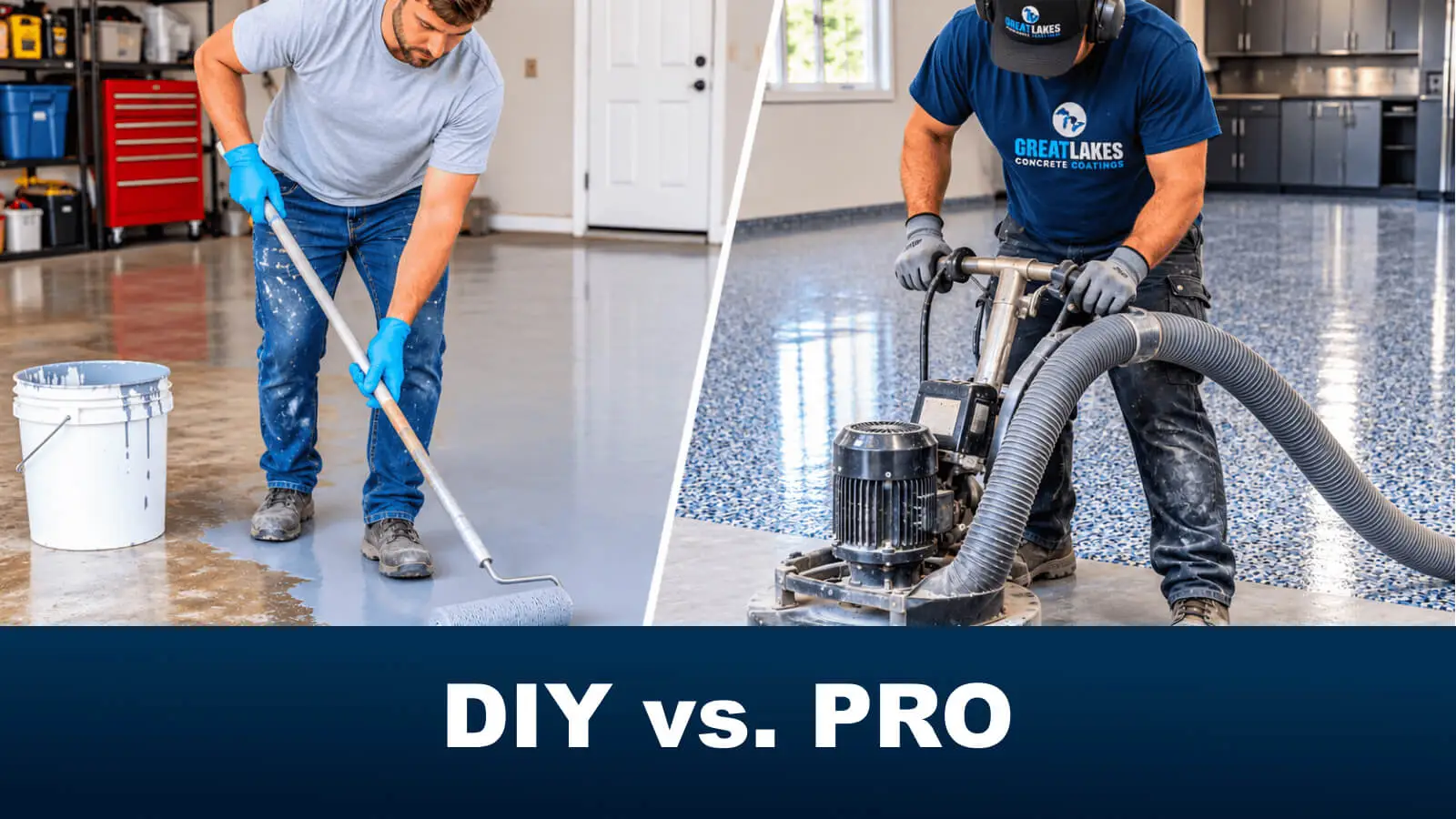
DIY vs. Professional Garage Floor Coating Guide
A professional garage floor coating provides industrial durability and a long lifespan, while a DIY kit offers a lower upfront cost but carries a higher risk of peeling, chipping, and wear over time. If you’re comparing DIY vs professional garage floor coating options for your Traverse City home, the real difference comes down to preparation, material quality, and what happens two winters from now.
Up here in Northern Michigan, garage floors take a beating—freeze-thaw cycles, road salt, hot tires, and oil spills. A DIY kit and a professional polyaspartic system are not the same product at different prices. One is a temporary film. The other is a structural bond.
This guide breaks down the five factors that actually matter: surface preparation, material quality, cost and value, durability and warranties, and time and curing. No hype. Just the comparison most homeowners never get before they buy a kit.
The Quick Answer
A professional garage floor coating provides industrial durability and a long lifespan. A DIY kit offers a lower upfront cost but carries a higher risk of peeling, chipping, and wear over time. That’s the trade-off in one sentence.
| Factor | DIY Kit | Professional System |
|---|---|---|
| Surface prep | Acid wash or light etching | Diamond grinding to open pores |
| Material | Water-based or low-solids epoxy | 100% solids epoxy, polyurea, or polyaspartic |
| Film thickness | 2–5 mils (thin, diluted) | About 1/8 to 1/4 inch |
| Upfront cost | $300–$400 for materials | $2,000–$3,000+ |
| Warranty | None or 1-year limited product only | 10 to 15 years, labor + material |
| Cure time | Several days | 24–48 hours to vehicle traffic |
| Typical lifespan | 2–5 years | 15–20+ years |
The bottom line: DIY saves money on day one. Professional saves money over the life of the floor. Which one matters more depends on how you use the garage—and how long you plan to stay.
Surface Preparation: The Foundation of Every Floor
Surface preparation is the single most important difference between a professional system and a DIY kit. It’s also the step most homeowners never see.
Professional Preparation
A professional installer uses heavy-duty diamond grinders and mechanical equipment to open the concrete pores, repair cracks, and ensure deep adhesion. The grinder removes the weak top layer of concrete, old sealers, and contaminants—leaving a rough, porous profile that the coating can physically bond into.
DIY Preparation
DIY kits typically rely on acid washing, scrubbing, or light etching. Acid washing barely cleans the surface, and it leaves the slab smoother than it started. That significantly increases the risk of the coating lifting or peeling—especially in a cold climate where the slab moves constantly.
For a deeper look at what proper preparation involves, see our guide on how to prepare a garage floor for coating.
The honest comparison: A mid-grade coating over a diamond-ground slab will outlast a premium coating over an acid-etched one. Prep isn’t a step—it’s the foundation.
Material Quality & Thickness
Not all “epoxy” is the same. The solids content tells you how much actual coating remains on the floor after the carrier evaporates.
Professional Materials
Professional systems use 100% solids epoxy, polyurea, or polyaspartic formulations with zero evaporating solvents. The result is a much thicker layer—about 1/8 to 1/4 inch—that resists hot tires, chemicals, and road salt. It’s also UV stable, so it won’t yellow or fade.
DIY Materials
DIY kits usually use water-based or low-solids box-store epoxies that are diluted and thin out as they cure. The film is 2–5 mils thick—barely enough to protect the concrete from abrasion, let alone Michigan winters. The material itself is also more brittle, which means it cracks when the slab moves.
If you want to understand the chemistry difference between coatings, see polyaspartic vs. epoxy.
Cost & Value: Up Front vs. Over Time
DIY kits look cheaper on the store shelf. Professional systems cost more up front. But the full story is in what happens next.
| Cost Factor | DIY Kit | Professional System |
|---|---|---|
| Upfront materials | $300–$400 | Included in install price |
| Upfront labor | Your time (13+ hours) | Included |
| Typical install total | $300–$400 | $2,000–$3,000+ |
| Lifespan | 2–5 years | 15–20+ years |
| Redo cost if it fails | Full removal + recoat | Warranty covers failure |
| Cost per year | $75–$200+ | $100–$200 |
What “Cheaper” Actually Costs
A DIY kit that lasts 3 years and then needs to be ground off and redone costs more total than a professional system that lasts 15–20 years. That’s before you count the time, the hassle, or the risk of a failed floor underneath your car.
For a full cost breakdown, see our polyaspartic garage floor cost guide.
Durability & Warranties
Durability isn’t just about how the floor looks in year one. It’s about how it holds up in year five—and who’s responsible if something goes wrong.
Professional Durability
Professional systems are 4x stronger than standard epoxy, impact and scratch-resistant, and UV stable. They resist hot-tire pickup, road salt, and chemical spills. And they’re backed by contractor or manufacturer warranties ranging from 10 to 15 years or lifetime coverage depending on the system.
DIY Durability
DIY kits lack professional warranty protection, placing all repair and stripping responsibilities on the homeowner. When the coating peels at the tire paths or yellows from sun exposure, there’s no one to call. The product warranty (if there is one) covers the bucket—not the labor, not the removal, not the floor.
The question to ask: “What happens if this fails in year three?” A professional installer has an answer. A DIY kit doesn’t.
Time & Curing
Time is the hidden cost of a DIY kit. Most homeowners underestimate it.
Professional Timeline
Applied quickly by a crew, with foot traffic and vehicle use permitted within 24 to 48 hours. A typical two-car garage is a one-day installation. You clear the space, the crew does the work, and you park the car the next day.
DIY Timeline
Labor-intensive—often taking 13+ hours of work—and requiring several days of curing. Add high vulnerability to dust, debris, and premature parking. If the garage is your only parking, that’s a week of finding somewhere else to put the car.
Why This Matters in Northern Michigan
Traverse City garages face conditions that punish weak coatings. Freeze-thaw cycles, road salt, and snow melt create constant stress on the coating-to-concrete bond.
- Freeze-thaw cycles: Concrete expands and contracts. Brittle DIY epoxy cracks. Flexible polyaspartic moves with the slab.
- Road salt: Salt works into thin films and undermines adhesion. A 100% solids system keeps it out.
- Hot tires: Warm tires on a cold day can tear a low-grade epoxy right off the surface.
- UV exposure: Sun through an open garage door yellows cheap epoxy. Polyaspartic stays clear.
For Traverse City homeowners: The combination of freeze-thaw and road salt is brutal on thin DIY films. If your garage holds a vehicle from November through March, a DIY kit is a gamble—and a professional polyaspartic system is the practical choice. Learn more about our Michigan-specific garage floor coatings.
When DIY Actually Makes Sense
We’re not going to pretend DIY is always the wrong call. It makes sense in a few specific cases:
- Low-traffic storage space: A shed or utility room where nothing drives in.
- Clean, dry, sound concrete: No cracks, no spalling, no moisture issues.
- Cosmetic refresh: You want a better look for 2–3 years and accept that it’s temporary.
- Budget is the only factor: You can’t afford professional right now and need something better than bare concrete.
But if the space is a daily driver garage exposed to road salt, snow melt, and hot tires—DIY is a temporary fix for a long-term problem.
Frequently Asked Questions
Is a professional garage floor coating worth the money?
For most homeowners with a daily driver garage, yes. A professional polyaspartic system lasts 15–20+ years, resists hot-tire pickup and road salt, and comes with a warranty. The cost per year of service is often lower than a DIY kit that fails in 3 years and needs to be removed and redone.
Why do DIY epoxy kits peel?
Three reasons: inadequate prep (acid washing instead of diamond grinding), no moisture testing, and thin film thickness (2–5 mils). The resin in the bucket is rarely the problem—the system around it is. When the bond fails, the coating peels.
How long does a DIY epoxy floor last?
Most DIY water-based epoxy kits last 2–5 years in a garage setting, depending on traffic and climate. In Northern Michigan, failure often happens within the first 2–3 winters due to freeze-thaw cycles and road salt.
What’s the difference between 100% solids and water-based epoxy?
100% solids epoxy contains no evaporating solvents—what you apply is what stays on the floor. Water-based epoxy is diluted and thins out as it cures, leaving a much thinner film. Professional systems use 100% solids for thickness and durability; DIY kits typically use water-based or low-solids formulas.
How long before I can park on a professional coating?
Most professional polyaspartic systems allow vehicle traffic after 24 to 48 hours. Foot traffic is usually safe within a few hours. Always follow your installer’s specific recommendations—cure times vary by temperature and humidity.
Can I diamond-grind my own concrete and use a DIY kit?
Yes—if you rent a diamond grinder, test for moisture, repair cracks, and follow the product’s recoat windows. The kit itself is the easy part. Prep is the hard part, and it’s where most DIY failures happen.
What does a professional warranty actually cover?
A meaningful warranty covers delamination and peeling for multiple years, from a company with a local presence that will still be in business to honor it. DIY kits typically have no warranty, or a limited product-only warranty that doesn’t cover labor or removal.
How much does a professional garage floor coating cost vs. DIY?
A DIY kit for a two-car garage runs $300–$400 in materials. A professional polyaspartic installation runs $2,000–$3,000+ depending on size and prep requirements. The DIY kit is cheaper up front, but most homeowners end up replacing a failed DIY floor within 3–5 years—paying for both the DIY kit and the professional install.
Conclusion
DIY vs professional garage floor coating isn’t a fair comparison. They’re different products designed for different outcomes. One is a temporary film. The other is an industrial-grade bond.
The real difference isn’t just the product—it’s the diamond grinding, the 100% solids chemistry, the flexibility of polyaspartic, the resistance to hot-tire pickup, and the warranty that covers the floor, not the bucket. DIY kits look cheaper on the shelf, but most homeowners find themselves grinding off a peeling mess to install a professional coating a couple of years down the line.
We do it right the first time so you never have to worry about it again.
Ready to upgrade your garage? Great Lakes Concrete Coatings installs professional polyaspartic systems across Traverse City and Northern Michigan. Whether you’re looking at a residential garage or a commercial space, we can walk you through custom flake color options and get you a free estimate. Call (231) 299-6960 or request a quote online.