
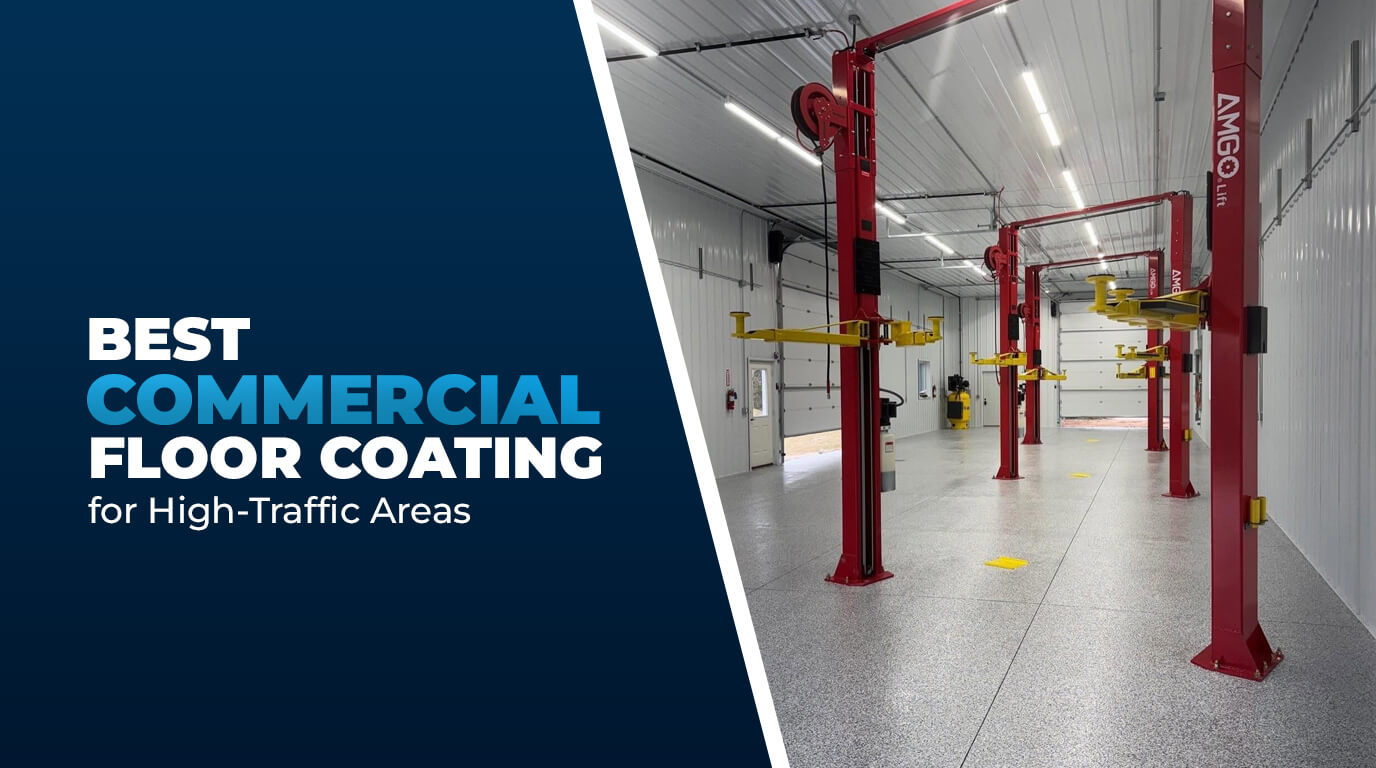
Best Commercial Floor Coating for High-Traffic Areas
If you manage a warehouse, showroom, retail space, or industrial facility, your floor takes a beating every single day. Forklifts, pallets, rolling carts, foot traffic, chemical spills, and constant cleaning—your floor has to handle all of it without failing.
The best commercial floor coating for high-traffic areas is a hybrid system: a high-build epoxy base coat paired with a polyaspartic topcoat. This combination delivers the abrasion resistance of epoxy with the UV stability, chemical resistance, and fast cure of polyaspartic. For facilities in cold climates like Northern Michigan, this is the system that holds up.
This guide compares the top commercial floor coating options—polyaspartic, epoxy, urethane cement, and decorative quartz systems—across the metrics that actually matter: abrasion resistance, maintenance, traffic tolerance, and lifecycle cost.
What Matters Most in High-Traffic Flooring
Not all commercial floors face the same demands. A retail showroom and a food processing plant have very different requirements. But across all high-traffic environments, four factors determine whether a coating succeeds or fails:
1. Abrasion Resistance
The floor’s ability to resist scratching, scuffing, and surface wear from constant traffic—foot, cart, forklift, or vehicle.
2. Traffic Tolerance
How the floor handles impact, rolling loads, thermal expansion, and the sheer volume of use. Some coatings crack under heavy loads; others flex.
3. Maintenance Requirements
How often the floor needs cleaning, what products are safe, and whether it can be sanitized. High-traffic floors need low-maintenance surfaces.
4. Lifecycle Cost
The total cost of the floor over its lifespan—not just the installation price. A cheaper floor that fails in 5 years costs more than a premium floor that lasts 20.
The best coating isn’t always the cheapest up front. It’s the one that delivers the lowest cost per year of service while meeting your facility’s specific demands.
Polyaspartic Coatings
Best for: Quick-turnaround retail spaces, automotive showrooms, lobbies, grocery stores, shopping centers, and any high-traffic facility where downtime must be minimized.
Polyaspartic coatings are engineered for environments where speed, durability, and aesthetics are all non-negotiable. They cure rapidly—often within 1 to 2 hours—allowing floors to return to full use much faster than traditional systems.
Their superior UV resistance ensures floors maintain clarity and color without yellowing, even under constant exposure to sunlight through large commercial windows.
Key Benefits
- Rapid cure times: Floors can return to service within hours—foot traffic in 2–6 hours, full reopening within 24.
- Extreme durability: Up to 4x stronger than traditional epoxy. Resists scratching, impact, and abrasion from constant traffic.
- UV stability: Won’t yellow, fade, or discolor in sunlight.
- Chemical and stain resistance: Resists harsh cleaning agents, oils, greases, and de-icing salts.
- Flexibility: Micro-bends under heavy loads and thermal expansion without cracking or peeling.
- Seamless and hygienic: No grout lines or seams. Easy to clean, naturally resistant to bacteria.
When to Choose Polyaspartic
Choose polyaspartic when project timelines are tight and downtime must be kept to an absolute minimum. If the facility operates around the clock—or has narrow installation windows like overnight or during off-hours—polyaspartic offers a major advantage with its fast return-to-service capabilities.
Epoxy Coatings
Best for: Warehouses, industrial storage, manufacturing facilities, and back-of-house commercial areas.
Epoxy coatings are a tried-and-true choice for commercial and industrial floors where durability, performance, and value are top priorities. They create a high-build, seamless surface that stands up to heavy traffic, impacts, and chemical exposure.
Although epoxies require a longer cure time compared to polyaspartics, their exceptional strength and versatility make them the preferred solution for spaces where long-term resilience matters more than rapid installation.
Key Benefits
- Outstanding impact and abrasion resistance for high-traffic environments
- Excellent adhesion to mechanically prepared concrete surfaces
- Customizable with decorative flake or quartz systems for texture, slip resistance, and aesthetics
- Range of finishes—matte to high-gloss—to match functional and design needs
- Cost-effective for large-scale projects with tight budgets
When to Choose Epoxy
Epoxy systems are the right fit when the project allows for a longer cure window and demands a high-performance, heavy-duty floor. They’re especially valuable for back-of-house and industrial settings where the focus is on function, strength, and ease of maintenance—not quick turnaround.
Important: Standard epoxy has a narrow temperature window (55–85°F) and can yellow under UV exposure. For high-traffic commercial spaces with sunlight exposure or cold-weather installation needs, a polyaspartic topcoat over an epoxy base is the better system.
Urethane Cement Systems
Best for: Food and beverage production facilities, commercial kitchens, pharmaceutical plants, clean rooms, chemical processing areas.
Urethane cement systems—also known as urethane mortar systems—are specifically designed to perform in the harshest environments where exposure to extreme thermal, mechanical, and chemical stresses are the norm.
These heavy-duty systems combine the strength of cement with the flexibility and chemical resistance of urethane, creating a seamless, non-porous surface that withstands intense daily abuse.
Key Benefits
- Exceptional thermal shock resistance: Withstands repeated high-temperature washdowns, steam cleaning, and fluctuating conditions
- Superior chemical resistance: Against acids, oils, fats, and aggressive cleaners
- Ultra-durable under heavy rolling loads and constant mechanical impact
- Seamless, non-porous surface inhibits bacterial growth and simplifies cleaning
- Moisture-tolerant installation: Can be applied over damp concrete without risk of failure
- Slip-resistant finishes available for wet or greasy conditions
When to Choose Urethane Cement
Choose urethane cement when the environment demands extreme durability, constant sanitation, and resistance to severe temperature fluctuations. If the facility undergoes daily high-temperature washdowns, chemical exposure, or operates heavy equipment around the clock, urethane cement provides a floor that won’t fail under pressure.
Decorative Quartz and Flake Systems
Best for: Retail floors, showrooms, corporate offices, medical facilities, fitness centers, salons, and public lobbies.
Decorative quartz and color chip (flake) systems deliver the perfect balance of performance and aesthetic appeal. Built as multi-layer systems—typically using epoxy or polyaspartic binders—these floors combine durability with visual customization.
Key Benefits
- Highly customizable: Wide range of colors, blends, and finishes to match brand themes
- Enhanced slip resistance: Textured finish can be tailored for traction
- Outstanding durability: Endures constant foot traffic, moving equipment, and routine cleaning
- Low maintenance: Smooth, sealed surfaces make cleaning simple
- Chemical and stain resistance: Resists spills from cleaning chemicals, food, oils
When to Choose Decorative Systems
- Design matters: You want a floor that enhances the space without sacrificing performance
- Slip resistance is a priority: Fitness centers, salons, healthcare facilities
- High foot traffic is expected: Entrances, corridors, public spaces
- Maintenance needs to stay simple: Easy-to-clean, stain-resistant floors
Comparison: Best Coating by Application
| Facility Type | Best System | Why |
|---|---|---|
| Warehouse / Distribution | Epoxy base + polyaspartic topcoat | Heavy abrasion resistance, fast return to service |
| Retail / Showroom | Polyaspartic with decorative flakes | Aesthetics, UV stability, fast cure |
| Food & Beverage | Urethane cement | Thermal shock resistance, chemical resistance, hygiene |
| Automotive Service | Polyaspartic / polyurea | Chemical resistance, hot tire pickup resistance |
| Healthcare / Lab | Polyaspartic (antimicrobial additive) | Antibacterial, seamless, chemical resistant |
| Commercial Kitchen | Urethane cement | Thermal shock, chemical resistance, slip resistance |
| Fitness Center | Polyaspartic with quartz | Slip resistance, durability, easy maintenance |
Lifecycle Cost: The Number Most People Miss
The installation price is only part of the story. The real number is lifecycle cost—the total cost of the floor over its service life, including:
- Initial installation
- Maintenance and cleaning products
- Repairs and patching
- Downtime during repairs
- Replacement cost (and how soon it’s needed)
| Coating | Typical Lifespan | Maintenance Level | Relative Lifecycle Cost |
|---|---|---|---|
| Polyaspartic | 20+ years | Low | Lowest per year |
| Epoxy | 10–15 years | Moderate | Moderate |
| Urethane cement | 15–20 years | Low | Moderate to low |
| Decorative quartz/flake | 15–20 years | Low | Low |
| Basic floor paint | 2–5 years | High | Highest per year |
Bottom line: Polyaspartic costs more up front, but over 20 years, it’s often the lowest total cost. A basic epoxy floor that fails in 5 years costs more than a premium system that lasts 20—especially when you factor in downtime.
Abrasion Resistance: Which System Wins?
Abrasion resistance is the single most important performance metric for high-traffic floors. It determines how long the floor looks new and how well it protects the concrete underneath.
| Coating | Abrasion Resistance | Impact Resistance | Notes |
|---|---|---|---|
| Polyaspartic | Excellent | Excellent | Flexes under load—absorbs impact |
| Epoxy (100% solids) | Excellent | Good | Harder film—can crack under impact |
| Urethane cement | Excellent | Excellent | Best for thermal shock and heavy loads |
| Decorative quartz | Very good | Good | Quartz aggregate adds surface hardness |
| Basic epoxy (big-box) | Poor | Poor | Thin film, softens under heat |
Why Polyaspartic Wins on Abrasion
Polyaspartic esters are capable of flexing—they absorb and redistribute force rather than cracking or shattering under it. This is why polyaspartic floors last upwards of 20 years in commercial settings.
Maintenance Requirements by System
High-traffic facilities can’t afford high-maintenance floors. Here’s how each system compares:
| Coating | Daily Cleaning | Deep Clean Frequency | Special Products Needed |
|---|---|---|---|
| Polyaspartic | Sweep or dust mop | Every 1–2 weeks | pH-neutral cleaner |
| Epoxy | Sweep or dust mop | Every 1–2 weeks | pH-neutral cleaner |
| Urethane cement | Hose down or scrub | Daily in food facilities | Approved sanitation chemicals |
| Decorative quartz | Sweep or dust mop | Every 1–2 weeks | pH-neutral cleaner |
Maintenance Best Practices
- Sweep daily to remove grit and debris that can scratch the surface
- Wet mop weekly or bi-weekly with a pH-neutral cleaner
- Clean spills immediately—even resistant coatings can stain if spills sit
- Avoid acidic or abrasive cleaners—they break down the topcoat
- Schedule professional inspections every few years to catch wear early
Why This Matters in Traverse City and Northern Michigan
Northern Michigan facilities face conditions that many commercial spaces don’t:
- Freeze-thaw cycles: Concrete expands and contracts. Brittle coatings crack. Polyaspartic flexes.
- Road salt: Tracked in by vehicles all winter. Salt breaks down low-quality coatings.
- Cold installation windows: Standard epoxy needs 55°F+. Polyaspartic can be applied at lower temperatures.
- UV exposure: Large commercial windows and loading docks. Epoxy yellows. Polyaspartic doesn’t.
For Traverse City and Northern Michigan facilities, the best commercial floor coating is a polyaspartic system—or a hybrid epoxy base with a polyaspartic topcoat. It handles the cold, the salt, the UV, and the traffic without the failure modes of standard epoxy.
Best Practices for High-Traffic Floors
- Test the concrete first. Moisture, contamination, and substrate condition determine what system will work.
- Mechanically prepare the surface. Diamond grinding or shot blasting achieves the profile needed for adhesion.
- Use a primer. A moisture vapor barrier primer is non-negotiable on grade-level slabs.
- Choose the right system for the traffic. Polyaspartic for UV and chemical exposure; urethane cement for thermal shock; epoxy base for heavy industrial loads.
- Consider a hybrid system. Epoxy base + polyaspartic topcoat gives you the best of both.
- Don’t skip crack and joint repair. Coatings bridge small cracks, but active cracks need repair first.
- Plan for downtime. Polyaspartic cures in hours. Epoxy takes days. Choose accordingly.
- Use the right cleaning products. pH-neutral cleaners only. Avoid bleach, ammonia, and citrus.
- Address spills immediately. Even the best coating can stain if spills sit.
- Schedule regular inspections. Catch wear early and patch before it spreads.
Frequently Asked Questions
What is the best commercial floor coating for high-traffic areas?
A hybrid system—high-build epoxy base coat with a polyaspartic topcoat—is the best overall choice for most high-traffic commercial spaces. It combines epoxy’s abrasion resistance with polyaspartic’s UV stability, chemical resistance, and fast cure. For food processing or chemical plants, urethane cement may be better.
How long does commercial floor coating last in high-traffic areas?
Polyaspartic systems typically last 20+ years in commercial settings. Epoxy lasts 10–15 years. Urethane cement lasts 15–20 years. Lifespan depends on traffic volume, maintenance, and installation quality.
Is polyaspartic better than epoxy for commercial floors?
For most commercial environments, yes. Polyaspartic cures faster, resists UV, and handles chemical exposure better than standard epoxy. Epoxy is still a strong choice for back-of-house industrial areas where UV isn’t a factor and longer cure times are acceptable.
What is the lifecycle cost of commercial floor coating?
Lifecycle cost includes installation, maintenance, repairs, downtime, and replacement. Polyaspartic costs more up front but often has the lowest cost per year of service because it lasts 20+ years. A cheap epoxy floor that fails in 5 years costs more overall.
How long does commercial floor coating take to cure?
Polyaspartic: foot traffic in 2–6 hours, full service in 24 hours. Epoxy: 3–7 days for full cure. Urethane cement: 24–48 hours. Faster cure means less downtime for your business.
Can you install commercial floor coating in cold weather?
Polyaspartic can be installed at lower temperatures (often 35–40°F) than standard epoxy (55°F+). For Northern Michigan facilities, this makes polyaspartic the practical choice for fall and winter installations.
What maintenance does a high-traffic commercial floor need?
Sweep daily, wet mop weekly or bi-weekly with a pH-neutral cleaner, clean spills immediately, and avoid acidic or abrasive cleaners. Schedule professional inspections every few years.
Is urethane cement better than polyaspartic?
They serve different purposes. Urethane cement is better for food processing, commercial kitchens, and chemical plants where thermal shock and aggressive chemicals are present. Polyaspartic is better for retail, showrooms, warehouses, and automotive facilities where UV stability and fast cure matter.
How much does commercial floor coating cost?
Polyaspartic: $6–$9 per square foot. Epoxy: $3–$7 per square foot. Urethane cement: $8–$12 per square foot. Decorative quartz: $5–$10 per square foot. Prices vary by location, substrate condition, and preparation requirements.
Can I coat over an existing commercial floor?
Sometimes. The existing coating must be firmly bonded, clean, and compatible. Loose or failing coatings need to be removed first. A small test area is recommended before committing to a full floor.
Conclusion
The best commercial floor coating for high-traffic areas depends on your facility—but for most businesses, a hybrid epoxy base with a polyaspartic topcoat delivers the strongest combination of abrasion resistance, UV stability, chemical resistance, and fast return to service.
For food processing and chemical environments, urethane cement is the better choice. For retail and showrooms, decorative polyaspartic systems add visual appeal without sacrificing durability.
Next step: If you manage a commercial facility in Traverse City or Northern Michigan, call Great Lakes Concrete Coatings at (231) 299-6960 for a free quote. We’ll assess your traffic, your substrate, and your downtime requirements—and recommend the system that gives you the lowest lifecycle cost.