

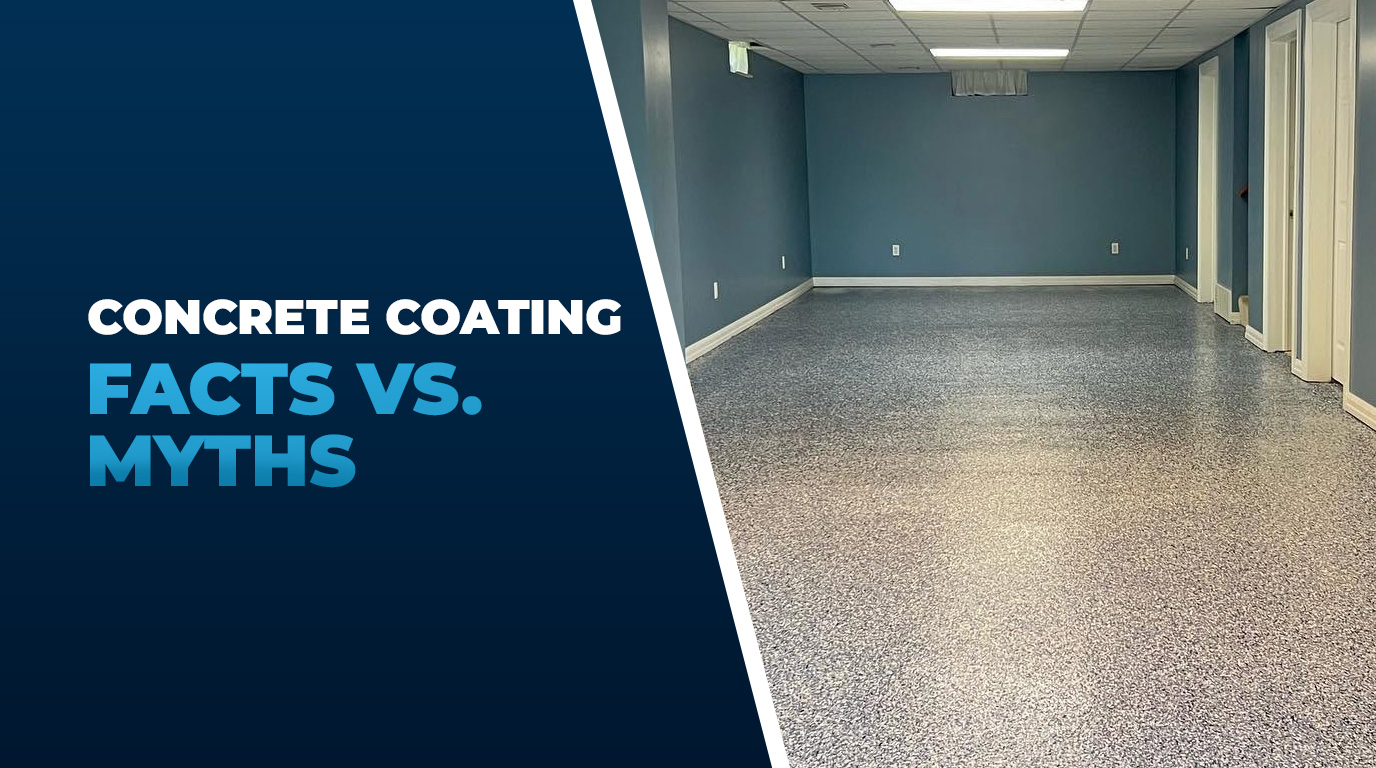
Concrete Coating Facts vs. Myths: What Homeowners Need to Know
If you’ve spent any time researching concrete coatings, you’ve probably run into conflicting information. Some sources say coatings last 20 years. Others say they peel within a year. Some say they’re maintenance-free. Others say they’re a constant chore. Who’s telling the truth?
The reality is that concrete coatings are neither magic nor a scam. They’re a legitimate home improvement with real benefits and real limitations. The problem is that most marketing skips the limitations—and most criticism skips the benefits.
This guide debunks the 10 most common concrete coating myths, explains the facts behind each one, and gives you an honest picture of what these coatings can and can’t do for your home. No hype. No fear-mongering. Just the truth.
Why Concrete Coating Myths Persist
Concrete coating myths exist for three reasons:
- Bad experiences. A homeowner used a cheap DIY kit, it failed, and now they believe all coatings fail. The problem wasn’t the coating—it was the product and the prep.
- Marketing exaggeration. Some companies promise “lifetime” performance and “zero maintenance.” That’s not true for any coating, and it sets unrealistic expectations.
- Confusion between product types. Epoxy, polyaspartic, polyurea, and acrylic sealers are all “concrete coatings.” But their performance, lifespan, and cost vary wildly. Treating them as one category creates myths.
The key to cutting through the noise: Stop asking “Are concrete coatings good?” Start asking “Which coating, installed how, for what application?”
1. All Concrete Coatings Are the Same
People often lump epoxy, polyaspartic, polyurea, acrylic sealers, and concrete paint into one category. They assume if one fails, they all fail.
FactConcrete coatings vary dramatically in chemistry, performance, and lifespan. A $50 DIY epoxy kit and a professional polyaspartic system are not the same product.
| Coating Type | Typical Lifespan | UV Stable | Best For |
|---|---|---|---|
| Acrylic Sealer | 1–3 years | Varies | Budget sealing, light use |
| Big-Box Epoxy Kit | 2–5 years | No | Light residential use |
| Professional Epoxy | 10–15 years | No | Indoor industrial, garages |
| Polyaspartic / Polyurea | 15–20+ years | Yes | Garages, pool decks, commercial |
| Urethane Cement | 15–20 years | No | Food processing, chemical plants |
2. Concrete Coatings Never Peel
Some installers claim their coatings “never peel.” That’s marketing, not reality. Any coating can peel if the conditions are wrong.
FactConcrete coatings peel when the bond between the coating and the concrete fails. The most common causes are:
- Inadequate surface preparation (the #1 cause)
- Moisture vapor pushing up through the slab
- Contamination (oil, grease, old sealers)
- Wrong temperature during application
- Improper mixing ratios
Roughly 85% of coating failures trace back to improper surface preparation—not the coating itself.
3. Concrete Coatings Are Maintenance-Free
“Install it and forget it” is a common claim. It’s not accurate.
FactConcrete coatings are low-maintenance, not maintenance-free. Every coating requires some care to stay looking good and performing well.
- Sweep or dust mop: Weekly to remove grit and debris
- Wet mop: Monthly with a pH-neutral cleaner
- Clean spills promptly: Even resistant coatings can stain if spills sit
- Inspect annually: Check edges, joints, and high-traffic areas
- Recoat topcoat: Every 5–10 years depending on use and exposure
4. Concrete Coatings Are Only for Garages
Garages get most of the attention, so many homeowners assume that’s the only application.
FactConcrete coatings are used in a wide range of residential and commercial spaces:
- Residential: Garages, basements, patios, pool decks, driveways, walkways, workshops, home gyms
- Commercial: Retail spaces, showrooms, restaurants, warehouses, auto shops, medical facilities
- Industrial: Manufacturing floors, food processing, chemical plants, loading docks
The best coating for each application varies. A pool deck needs slip resistance and UV stability. A garage needs chemical resistance and hot tire pickup resistance. A food processing floor needs thermal shock resistance and hygiene.
5. Concrete Coatings Are Too Expensive
Homeowners often compare the cost of a professional coating to a bucket of concrete paint. That’s not a fair comparison.
FactProfessional concrete coatings cost more up front than paint or DIY kits. But the lifecycle cost is often lower.
| Option | Upfront Cost | Lifespan | Cost Per Year |
|---|---|---|---|
| Concrete Paint | $0.50–$1.50/sq ft | 1–3 years | $0.50–$1.50 |
| DIY Epoxy Kit | $1–$3/sq ft | 2–5 years | $0.20–$1.50 |
| Professional Epoxy | $3–$7/sq ft | 10–15 years | $0.20–$0.70 |
| Polyaspartic System | $6–$9/sq ft | 15–20+ years | $0.30–$0.60 |
When you factor in the cost of redoing a failed cheap coating—plus the downtime and frustration—the premium system often costs less per year of service.
6. You Can Coat Over Any Concrete
Some homeowners assume any concrete surface can be coated. Just roll it on and you’re done.
FactNot all concrete is coatable—at least not without repairs first. Coatings require a sound, clean, dry substrate. Problem conditions include:
- Spalling or crumbling concrete: The surface is too weak to hold a coating
- Active cracks: Cracks that move with temperature or settling will telegraph through
- High moisture vapor: Moisture pushing up from below will delaminate the coating
- Heavy oil or grease contamination: Prevents adhesion unless properly removed
- Existing coatings that are failing: The new coating inherits the old coating’s failure
7. Concrete Coatings Last Forever
“Lifetime warranty” claims create the impression that coatings never need attention.
FactNo coating lasts forever. Even the best polyaspartic systems have a service life. What “lifetime” usually means is the warranty period, not the actual lifespan.
- Acrylic sealer: 1–3 years
- DIY epoxy: 2–5 years
- Professional epoxy: 10–15 years
- Polyaspartic: 15–20+ years
- Urethane cement: 15–20 years
With proper maintenance and occasional topcoat renewal, a quality coating can last decades. But “forever” isn’t a real number.
8. Concrete Coatings Are Slippery
Smooth, glossy coatings can be slippery when wet—especially epoxy and polyaspartic without texture.
FactCoatings can be engineered for slip resistance. The right anti-slip additive—polymer grit, aluminum oxide, or silica sand—creates texture that meets wet slip resistance standards.
| Additive | Traction | Barefoot Comfort | Best For |
|---|---|---|---|
| Polymer Grit | Moderate | Excellent | Pool decks, patios |
| Fine Aluminum Oxide | High | Good | Garages, steps |
| Coarse Aluminum Oxide | Very High | Poor | Ramps, commercial |
| Silica Sand (#70) | Moderate-High | Very Good | Pool decks, barefoot areas |
9. DIY Kits Work Just as Well
Big-box stores sell epoxy kits for a few hundred dollars. Why pay thousands for a professional install?
FactDIY kits and professional systems are fundamentally different products.
| Factor | DIY Kit | Professional System |
|---|---|---|
| Solids content | 50–70% | 100% |
| Film thickness | 2–5 mils | 10–30 mils |
| Surface prep | Acid etch (often inadequate) | Diamond grinding (CSP 3) |
| Layers | 1–2 | 3–5 (primer, base, flake, topcoat) |
| UV stability | Poor (yellows) | Excellent (polyaspartic) |
| Lifespan | 2–5 years | 15–20+ years |
A DIY kit can work for a light-use utility space if you prep correctly. But for a garage that sees vehicles, road salt, and hot tires, a professional system is a different category of product.
10. Concrete Coatings Are Just Paint
Some homeowners think of concrete coatings as thick paint. That leads to the assumption that they’ll wear out like paint.
FactConcrete coatings are not paint. Paint is a decorative film that sits on the surface. Coatings are resin-based systems that chemically bond to the concrete and cure into a hard, protective layer.
- Paint: Water or solvent-based, thin film, decorative, 1–3 year lifespan
- Epoxy/Polyaspartic: Two-part chemical system, thick film, protective, 10–20+ year lifespan
- Urethane cement: Cementitious-urethane hybrid, heavy-duty, 15–20 year lifespan
The chemistry is completely different. So is the performance.
Real Limitations of Concrete Coatings
Honesty matters more than hype. Here’s what concrete coatings can’t do:
- Fix structural problems. If the concrete is crumbling, spalling, or has structural cracks, a coating won’t solve that. Repairs come first.
- Stop moisture vapor. A coating can slow moisture, but it can’t stop it. High vapor transmission needs a moisture barrier primer or a different solution.
- Last forever. Every coating has a lifespan. Expect topcoat renewal every 5–10 years depending on use.
- Be truly maintenance-free. Low-maintenance, yes. Zero-maintenance, no.
- Work over any substrate. Contaminated, wet, or unstable concrete needs repair or remediation before coating.
- Be applied in any condition. Temperature, humidity, and dew point matter. Standard epoxy needs 55°F+. Polyaspartic can go lower but still has limits.
- Be installed perfectly by a DIYer in a weekend. Proper surface prep requires diamond grinding, which most homeowners don’t have.
An honest contractor will tell you when a coating isn’t the right solution. If your concrete has serious moisture, structural damage, or contamination, the right answer may be repair first—or a different flooring option entirely.
Myth vs. Fact: Quick Reference
| Myth | Fact |
|---|---|
| All coatings are the same | Chemistry and lifespan vary dramatically |
| Coatings never peel | They peel when prep is inadequate—85% of failures trace to prep |
| Coatings are maintenance-free | They’re low-maintenance—sweep weekly, mop monthly |
| Only for garages | Used in basements, patios, pool decks, commercial, industrial |
| Too expensive | Cost per year is often lower than cheap alternatives |
| Can coat over anything | Requires sound, clean, dry, prepared concrete |
| Last forever | 15–20+ years with maintenance; topcoat renewal every 5–10 |
| Always slippery | Anti-slip additives make them safe when wet |
| DIY works just as well | DIY kits are 50–70% solids vs 100% professional |
| It’s just paint | Two-part chemical systems, 10–30 mils thick, chemically bonded |
Frequently Asked Questions
Are concrete coatings worth the money?
For most homeowners, yes—if the concrete is in good condition and the coating is professionally installed. Concrete coatings protect the slab, improve appearance, reduce maintenance, and last 10–20+ years depending on the system. The cost per year of service is often lower than cheap alternatives that fail early.
How long do concrete coatings actually last?
Acrylic sealers last 1–3 years. DIY epoxy kits last 2–5 years. Professional epoxy lasts 10–15 years. Polyaspartic systems last 15–20+ years. Urethane cement lasts 15–20 years. Lifespan depends on product quality, surface prep, traffic, and maintenance.
Do concrete coatings really peel?
They can—but peeling is almost always a preparation problem, not a product problem. About 85% of coating failures trace back to inadequate surface preparation, moisture vapor, or contamination. A properly installed coating over properly prepared concrete can last decades without peeling.
Can I apply a concrete coating myself?
You can apply a DIY kit yourself, but the results are limited. DIY kits are 50–70% solids, 2–5 mils thick, and typically use acid etching instead of diamond grinding. Professional systems are 100% solids, 10–30 mils thick, and use mechanical preparation. For a garage or high-traffic area, professional installation is worth the investment.
Are concrete coatings slippery when wet?
Smooth coatings can be slippery when wet. But anti-slip additives—polymer grit, aluminum oxide, or silica sand—create texture that meets wet slip resistance standards. If slip resistance matters for your application, ask your contractor about texture options.
How much do concrete coatings cost?
Professional epoxy: $3–$7 per square foot. Polyaspartic systems: $6–$9 per square foot. Urethane cement: $8–$12 per square foot. DIY kits: $1–$3 per square foot. The upfront cost is higher for professional systems, but the cost per year of service is often lower because they last longer.
Do concrete coatings need maintenance?
Yes—but it’s minimal. Sweep or dust mop weekly, wet mop monthly with a pH-neutral cleaner, clean spills promptly, and inspect annually. A clear topcoat may need to be reapplied every 5–10 years depending on traffic and exposure.
Can concrete coatings be applied over old concrete?
Sometimes. The old concrete must be sound, clean, dry, and free of failing coatings or heavy contamination. Cracks, spalling, and moisture issues need to be addressed first. A good contractor will inspect the slab before quoting.
What’s the difference between epoxy and polyaspartic?
Epoxy is a two-part resin that cures hard and offers excellent abrasion resistance, but it yellows under UV exposure and cures slowly. Polyaspartic is a polyurea-based coating that cures faster, resists UV, and handles chemical exposure better. Polyaspartic costs more but lasts longer and performs better in sunlight.
Are concrete coatings safe for indoor air quality?
Polyaspartic coatings are low-VOC or zero-VOC, making them a good choice for indoor applications. Standard epoxy may have higher VOC content. Always check the product’s safety data sheet and ensure proper ventilation during installation and cure.
Conclusion
The truth about concrete coatings sits between the hype and the criticism. They’re not magic. They’re not a scam. They’re a durable, long-lasting home improvement—when the right product is installed over properly prepared concrete.
The myths persist because people compare apples to oranges. A $50 DIY epoxy kit and a professional polyaspartic system aren’t the same product. A properly prepped slab and a contaminated one aren’t the same substrate. A maintained floor and a neglected one aren’t the same floor.
Next step: If you’re considering a concrete coating for your garage, basement, patio, or pool deck in Traverse City or Northern Michigan, call Great Lakes Concrete Coatings at (231) 299-6960 for a free quote. We’ll inspect your concrete, explain what’s possible, and tell you honestly whether a coating is the right solution for your floor.